When a storm knocks out water and sewer service, Ankeny Porta Pros can usually get sanitation units on site within 24 hours, with standard units running $100 to $350 a day depending on order size and site access. Flooding, tornado damage and extended outages all qualify. We work with property managers, churches and disaster response teams across the metro.
Water main breaks, sewer backups, tornado damage and flood response all create the same problem fast: people still need a working toilet even when the building doesn't have one. Ankeny sits close enough to Johnston, about 10.2 miles southwest, and Altoona, roughly 12.5 miles southeast, that we can stage units regionally and move them wherever the damage is worst. This page covers how disaster sanitation actually works, what OSHA and ADA require even in an emergency, and what it costs.
Most emergency orders in Ankeny move within 24 hours of the call, sometimes same-day if a unit is already staged nearby. A standard porta potty rental sits about 44 by 48 inches on the ground and stands roughly 92 inches tall, so it fits on driveways, parking lots and staging areas without much site prep. Delivery does need clearance: a roll-off or trailer drop typically wants about 60 feet of straight approach behind the truck, which matters if streets are blocked by debris or downed lines. For water and sewer outages that affect an entire building, we often pair portable restroom rental units with a handwashing station rental so people have both, since OSHA 1926.51(a)(1) requires an adequate supply of potable water at any place of employment, disaster response sites included. If your event or shelter needs something faster than a standard call-in, our emergency porta potty rental page covers rush ordering directly. Response teams working multiple counties can also check Urbandale, about 16.9 miles southwest, or Clive, roughly 18.4 miles southwest, for staged units when Ankeny inventory runs tight during a wide-area event.
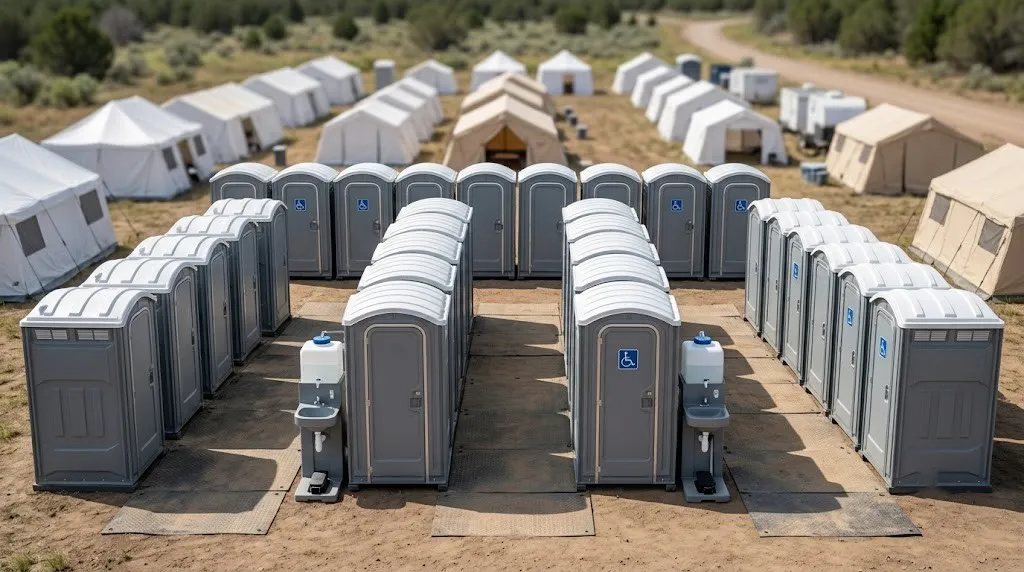
OSHA sanitation rules don't pause for a disaster, and they still apply to any crew doing recovery or cleanup work. Construction-style crews clearing debris fall under OSHA 1926.51(c), which sets facility counts based on crew size: one toilet for 20 workers or fewer, then additional fixtures as headcount climbs. If your crew is spraying disinfectant, mold treatment or other coatings during cleanup, OSHA 1926.51(f)(1) requires washing facilities for that specific work. General industry crews, like a business reopening after flood damage, fall under 1910.141(c)(1)(i) instead, and 29 CFR 1910.141(d)(2) requires soap and towels or a hand-drying device at any washing station, not just sanitizer. Shelters and public-facing sites need to think about accessibility too: ADA Standards section 213.2 requires at least one accessible unit in any cluster of portable toilets, and section 304.3.1 calls for a 60 inch turning circle inside. Our ADA accessible porta potty units meet those specs, and if you're setting up a shelter or command post from scratch, the how many porta potties do I need guide and OSHA portable toilet requirements page walk through the math by headcount. Fencing off a damaged structure or debris pile often calls for temporary fence rental as well, since OSHA 1926.202 requires barricades meeting ANSI D6.1 around hazards.
Pricing depends on unit type, order size and how long the response runs. A single-day emergency call costs more per unit than a week-long deployment, so most disaster response accounts settle into a weekly or monthly rate once the immediate crisis passes.
| unit | day | week | month |
|---|---|---|---|
| standard | $100-$350 | $130-$500 | $125-$325 |
| ada | $200-$400 | $240-$400 | -- |
| deluxe | $85-$1,200 | $150-$290 | -- |
Delivery fees run separately, typically $100 to $500 for a single-day rush and $120 to $420 for month-long deployments. If your response includes debris removal, a roll-off dumpster rental or construction dumpster rental usually gets ordered alongside the toilets, since flood and storm debris fills dumpsters fast under OSHA 1926.25 housekeeping rules and 1926.252 disposal requirements. Longer recovery efforts sometimes need a place for displaced staff to work, which is where a mobile office trailer rental or storage container rental comes in. Full cost breakdowns live on porta potty rental cost and monthly porta potty rental if your timeline stretches past a few weeks.
It depends on population, but the general industry ratio under 1910.141(c)(1)(i) scales with headcount, and construction crews follow 1926.51(c) instead. A shelter housing 100 people overnight needs more than a single unit. Call us with your expected count and we'll size it correctly the first time.
Usually yes, but we need roughly 60 feet of straight clearance behind the delivery truck. Tell us about downed trees, flooding or barricades when you call so we can route around them or use a smaller vehicle.
Yes. A portable sink rental or handwashing station can deploy on its own, which matters for kitchens, medical triage tents or any spot where 29 CFR 1910.141(d)(2) applies and sanitizer alone won't satisfy the requirement.
Field sanitation still applies under OSHA 1928.110, which sets one facility per 20 hand-labor employees within a quarter mile walk. See farm and agricultural restrooms for how that works on damaged rural sites.
As long as the response requires. Many disaster deployments start on a daily rate and shift to weekly or monthly billing once recovery becomes a longer project instead of an emergency call.
Yes. Ankeny Porta Pros delivers disaster relief sanitation across Ankeny and the surrounding metro, with same-day and next-day drop-off available on most orders.
Pricing depends on the unit and how long you need it. See our cost breakdown and request a free quote for an exact figure.
Standard rentals include scheduled service — a pump-out, a clean, a restock and fresh deodorizer. Busy or hot-weather sites can be serviced more often.
Call now or request a free quote — clean units, on-time delivery, transparent pricing.